
With a passion for turning data complexity into clarity, Jessica Sandifer is an experienced content manager who crafts stories that resonate across technical and business audiences. At DataGalaxy, she creates content and product marketing messages that demystify data governance and make AI-readiness actionable.
2025’s top 10 data governance best practices for modern data teams
14 August 2025 │ 8 mins read │ Data Governance by Jessica Sandifer, Tech writer

The pressure on your data teams has never been greater.
Data volumes are multiplying. AI tools and platforms are proliferating. Every decision, insight, and risk now traces back to one critical question: Can we trust our data?
As the backbone of reliable, scalable, and AI-ready operations, data governance’s moment has arrived once again.
With this in mind, here are 10 data governance best practices every modern data team should adopt, whether building from scratch or adapting to the demands of AI and analytics.
Start here: What is data governance?
Data governance is the operating system behind your data. It defines the roles, rules, and processes that keep data accurate, secure, and usable across every team, system, and use case.
For modern organizations, it also supports decision-making, AI deployments, and quality.
When governance works, it’s invisible. But when it fails? Chaos.
Data governance matters more now than ever before
AI models need trusted, well-documented, bias-aware data. Analysts can’t deliver insight if data is inconsistent or missing key context, and compliance teams can’t manage risk without knowing where sensitive data lives and how it’s used.
Governance gives modern data teams the structure to grow, the guardrails to stay compliant, and the context to make data meaningful, not just available.
That’s the “Why?” Now, let’s move to the “How?”
Here are 10 data governance best practices every modern data team should adopt, whether building a strategy from scratch or meeting the demands of AI, analytics, and scale.
Top 10 data governance best practices for modern data teams
1. Designate ownership & accountability
Data without an owner is data without a future.
Modern governance starts by assigning responsibility. Data owners oversee accuracy, availability, and relevance for specific domains. Data stewards manage day-to-day quality, compliance, and access.
However, titles alone aren’t enough. Follow these key points to make ownership actionable:
Define roles and responsibilities in your governance framework
Use workflow tools to assign and track accountability
Align ownership with incentives that reflect the value of trustworthy data
When everyone knows who’s responsible, issues are resolved faster, policies are enforced consistently, and governance strategy flourishes.
2. Define & document policies and procedures
If ownership is the “Who?”, policies and procedures are the “How?”.
You can’t rely on tribal knowledge or good intentions. Clear documentation on data handling and use is essential for trust, compliance, and AI readiness.
Data classification standards
Lifecycle management policies
Access and usage rules
Approval workflows
The key? Keep it practical. Avoid dense, legalistic language that nobody reads. Governance documentation should read as easily as a Slack message. Short, clear, and built for action.
3. Use a business glossary
A business glossary not only defines terms but also aligns people.
It’s where folks go to clarify what “Customer” means in marketing vs. finance, or whether “Active” includes users who opted out last quarter. A glossary strengthens communication and builds alignment across teams.
Designing data & AI products that deliver business value
To truly derive value from AI, it’s not enough to just have the technology.
- Clear strategy
- Reasonable rules for managing data
- Focus on building useful data products

The best glossaries do more than live in a document. They connect to live metadata. Terms are linked to real data assets, owners, and context for use.
An enlightened business glossary shows data in action, and it’s not just for humans. Clearly crafted definitions reduce ambiguity in training data, helping AI models learn faster and perform better.
4. Craft a dynamic metadata management strategy
Metadata makes data discoverable, understandable, and trustworthy, but the metadata strategy defines how that happens.
A strong MDM strategy must be dynamic: connected to live environments, updated continuously, and enriched through automation.
Think APIs, real-time connectors, and integrated catalogs that evolve alongside your data. Critical to lineage, quality, AI explainability, and compliance, metadata anchors your entire governance foundation.
The goal is to make metadata actionable, not academic. When someone asks, “What does this data mean?” or “Where did it come from?” they receive answers in real-time.
5. Keep a close eye on data quality
You can’t fix what you can’t see, and even minor quality gaps can skew AI predictions.
That’s why continuous monitoring isn’t optional.
Modern frameworks demand constant visibility into the health of their data pipelines.
Here’s how to make it happen:
Employ automation to scan continuously for data accuracy, completeness, and freshness
Set automated alerts to flag issues before they cascade through reports, models, and compliance workflows
Assess quality in context, understanding not just that a problem exists but why it matters based on business rules and downstream impact
The best monitoring tools integrate with live metadata and connect to every point in the data lifecycle. This gives your data stewards and owners the heads-up they need before things go sideways.
Catch issues early. Solve them fast. Keep quality where it belongs: Front and center.
6. Enable scalability
If your framework only works for today’s volume, tooling, and team size, you’re already behind.
Scalability is what separates short-term patches from long-term strategy.
The 3 KPIs for driving real data governance value
KPIs only matter if you track them.
Move from governance in theory to governance that delivers.
Download the free guideSo, what does scalable governance look like?
It’s modular
Policies, roles, and workflows should flex to accommodate new domains, teams, and data products easily.
It’s automated
Manual enforcement doesn’t scale. Automate where possible so governance grows without adding overhead.
It’s federated
Centralized control with distributed execution means teams stay aligned without bottlenecks.
As data volumes grow, governance should feel lighter, not heavier. If every new initiative requires reinvention, it’s time to redesign.
7. Encourage a strong data culture & data literacy
The best governance framework in the world is useless if no one understands, trusts, or uses it.
Governance isn’t just a system. It’s a mindset.
To make it work, everyone must consider data quality and stewardship as part of their job. Build a culture where data is both a shared asset and responsibility.
Here’s how to get there:
Make governance transparent
When teams see policies, data lineage, and quality scores in action, they’re more likely to engage.
Invest in education
Don’t assume data literacy is universal. Ongoing training helps everyone—from analysts to executives—understand the value of good governance.
Celebrate good behavior
Highlight data wins. Recognize those who offer improvements to documentation or help others resolve governance-related data issues.
Strong governance is modeled freely, not imposed.
8. Leverage existing governance tools
Not every governance initiative needs to start from scratch.
Use tools already in place for quality checks, lineage, and compliance. The key is connecting those tools in a cohesive, visible governance layer that supports everyday workflows.
Start by assessing what you already have:
- Metadata management platforms that house glossaries, policies, and lineage data
- Collaboration tools where decisions happen (Slack, Teams, Notion)
- Data quality monitors that surface errors, gaps, and outliers in real time
Then, look for ways to align and extend:
Integrate quality scores directly into dashboards and analytics tools
Embed glossaries into BI tools so terms are clear where insights are delivered
Connect governance rules to actual workflows, not just documentation
The goal isn’t to buy more; it’s to connect more. Make governance part of the day-to-day, not a conceptual philosophy no one sees or remembers.
9. Automate when possible (and plausible!)
Manual processes can’t scale. The volume and velocity of modern data demand automation, especially repetitive, high-volume tasks.
But here’s the trick: You have to automate the right things.
Start with:
Validation rules that check data at ingestion or transformation
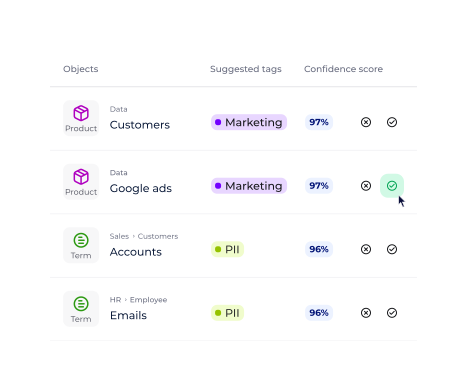
Policy enforcement for access control, retention, and sensitivity tagging
Notifications and escalations when anomalies or noncompliance occur
Lineage capture that automatically tracks changes across systems
But don’t automate everything. Governance needs human judgment, especially when resolving data conflicts, updating policies, or aligning cross-functional priorities.
Blink, your AI Copilot
Ask questions. Get answers. Drive action.
Blink helps every user explore, understand, and use data in their daily work. No tickets, no filters, no delays. Ask anything in your native language and get trusted, contextual answers and recommendations.
Meet Blink!So, strike a balance: Automate where scale is needed and keep people in the loop where nuance matters.
10. Start with what you have & iterate from there
You don’t need a blank slate to build great governance. Trying to “start fresh” often means discarding valuable context, relationships, and institutional knowledge.
Instead:
Begin with the data products your teams already use and trust
Identify what’s working—and what’s missing
Build governance frameworks around those high-value assets
Use early wins to gain momentum and expand from there
This approach grounds your strategy in reality.
It respects what your teams have built and focuses your energy where it matters most: Delivering value quickly.
Build the data governance framework your future needs
You don’t need to govern everything all at once.
Start small. Pick a few high-impact data products. Establish clarity, build confidence, and show the business what great governance looks like in action.
Then scale.
And as AI becomes part of every data workflow, strong governance keeps your data usable, explainable, and ready for what’s next.
FAQ
- What is AI governance?
-
AI governance is the framework of policies, practices, and regulations that guide the responsible development and use of artificial intelligence. It ensures ethical compliance, data transparency, risk management, and accountability—critical for organizations seeking to scale AI securely and align with evolving regulatory standards.
- What are the key principles of AI governance?
-
Key principles of AI governance include transparency, accountability, fairness, privacy, and security. These principles guide ethical AI development and use, ensuring models are explainable, unbiased, and compliant with regulations. Embedding these pillars strengthens trust, reduces risk, and supports sustainable, value-driven AI strategies aligned with organizational goals and global standards.
- How can organizations implement AI governance?
-
Organizations implement AI governance by developing comprehensive frameworks that encompass policies, ethical guidelines, and compliance strategies. This includes establishing AI ethics committees, conducting regular audits, ensuring data quality, and aligning AI initiatives with legal and societal standards. Such measures help manage risks and ensure that AI systems operate in a manner consistent with organizational values and public expectations.
- How do I start a data governance program?
-
To launch a data governance program, identify key stakeholders, set clear goals, and define ownership and policies. Align business and IT to ensure data quality, compliance, and value. Research best practices and frameworks to build a strong, effective governance structure.
- What are the key principles of effective value governance?
-
Value governance is important because it ensures data and digital initiatives drive measurable business outcomes. It aligns projects with strategic goals, optimizes resource allocation, and maximizes ROI. By prioritizing value delivery, organizations reduce waste, improve accountability, and accelerate transformation—making value governance essential for sustainable growth and competitive advantage in the data-driven era.
At a glance
- Modern data governance is essential for ensuring data trust, AI readiness, and compliance by defining clear ownership, policies, and metadata strategies.
- Scalable, automated, and culture-driven governance frameworks enable high-quality, secure, and well-documented data that supports both current needs and future growth.
- Starting with existing assets and iterating over time delivers quick wins, fosters adoption, and builds a sustainable governance foundation for the AI era.
Related posts

Implementing effective data governance in 8 easy steps
Today, organizations recognize the critical role of data governance in managing and leveraging their data effectively. Implementing data governance is essential to ensure data quality, regulatory compliance, and data-driven decision-making. By establishing a solid data governance framework, organizations can unlock the full potential of their data assets and drive business success. This article outlines eight crucial steps to […]
Data governance in 2026: Benefits, business alignment, and essential need
In a world where data has become more vital than ever, understanding how to effectively manage and utilize this resource is essential. One approach that continues to gain attention is data governance. The benefits of data governance can impact an organization at multiple levels by driving better decision-making, improving operational efficiency, and fostering regulatory compliance. TL;DR […]
The top 8 best practices for successful data governance implementation
Data may be the fuel of modern business, but without governance, it can just as easily create chaos as it can create value. Data governance is the framework that ensures every piece of information in your organization is accurate, secure, accessible, and trusted—the invisible operating system that keeps analytics, AI initiatives, and everyday decision-making on […]
Why is data governance important in an AI-first world?
Data governance isn’t new. But in an AI-fueled, risk-heavy, insight-obsessed world, it’s never mattered more. Today, data isn’t just a byproduct of doing business: it is the business. It powers AI models, shapes customer experiences, drives strategy, and fuels growth. But without a dynamic data governance program? Good luck. Inconsistent formats. Unknown sources. Conflicting definitions. […]
Data governance & observability: 3 steps to combined value
Data governance and data observability are interdependent. While governance establishes the rules and standards for data management, data observability ensures those rules are being followed in real-time. Together, they create a feedback loop that reinforces data trust and AI readiness. This article will discuss the basics of data governance and observability, discuss the best options to […]
Data products: Define, build, and deliver real value
According to Gartner, 50% of Chief Data and Analytics Officers (CDAOs) say they’ve already deployed data products. But the real question is: What exactly is a data product, and how do you build one that delivers tangible value? In this blog, we’ll explore how to define, design, and deliver data products that go beyond the […]