About the author: Max Faivre
Product Marketing Manager

As organizations connect AI assistants and agents to enterprise data, several familiar parts of the data stack are taking on new roles. Data catalogs organize and govern data knowledge. Semantic layers standardize business meaning. Governance systems define how information should be used. Now, the context layer is emerging as a way to make this knowledge available to AI.
This can make the architecture sound more complicated than it needs to be.
A context layer does not necessarily replace the data catalog or semantic layer. Instead, it builds on the knowledge these systems already create and helps make the right information available when an AI application needs to understand or act on enterprise data.
For a broader introduction to the concept, start with our guide to what a context layer is.
| Data catalog | Semantic layer | Context layer | |
|---|---|---|---|
| Primary purpose | Organize, discover, understand, and govern data | Standardize business meaning and calculations | Make relevant enterprise knowledge usable by AI |
| Core information | Metadata, ownership, definitions, lineage, quality, policies, usage | Metrics, dimensions, entities, relationships, business logic | Meaning, relationships, trust, governance, and relevant operational context |
| Main question | What data exists, what does it mean, and can I trust it? | How should this business concept or metric be defined? | What does AI need to know to use this information correctly? |
| Typical consumers | Data teams, analysts, governance teams, business users | BI tools, analysts, data teams, AI applications | AI assistants, agents, applications, developers, and people |
| Role in AI | Provides governed enterprise metadata and knowledge | Provides consistent semantics and business logic | Brings relevant knowledge together at the point of use |
The overlap between these technologies is not a weakness. It is precisely what makes them useful together.
A data catalog organizes knowledge about the data an organization owns. Modern catalogs go well beyond listing databases, tables, and columns. They can connect technical metadata with definitions, ownership, lineage, governance, quality signals, policies, and usage information.
For people, this helps answer familiar questions: What data exists? Which dataset should I use? What does this field mean? Who owns it? Where did it come from? Can I trust it?
AI systems need answers to many of the same questions.
An AI assistant searching across an enterprise data estate should be able to distinguish a trusted Finance dataset from an obsolete table, understand which business term is connected to a field, or trace a metric back to its source. That makes the catalog a natural source of context for AI.
The DataGalaxy Catalog connects metadata, lineage, ownership, business knowledge, and governance in a shared foundation designed for both technical and business users.
A semantic layer translates technical data structures into consistent business concepts. Instead of asking every dashboard, analyst, or AI application to interpret raw data independently, it provides shared definitions for metrics, dimensions, entities, calculations, and relationships.
Imagine several systems contain data related to revenue. A semantic layer can establish what the organization means by revenue, how the metric should be calculated, and which dimensions can be used to analyze it.
This is increasingly important for AI. If a user asks an assistant, “What was our churn rate last quarter?”, the AI should not infer a definition from column names. It should use the business logic the organization has already agreed on.
You can go deeper in our guide to using the semantic layer.
The semantic layer therefore contributes a critical part of context: consistent business meaning.
A context layer addresses a broader question: what does an AI system need to know about the organization to use information correctly?
The answer may include definitions from a semantic model, but it may also include lineage, ownership, certification, quality, permissions, policies, relationships, provenance, and other organizational knowledge.
That information will rarely come from a single system. The data catalog may provide ownership and lineage. The semantic layer may provide business logic. Governance systems may provide policies. Data quality platforms may provide reliability signals.
The context layer brings together the relevant knowledge for the task at hand.
This is why it is useful to think of the context layer as an activation layer for enterprise knowledge, rather than a new repository that replaces everything underneath it.
| Question | Most relevant foundation | Why |
|---|---|---|
| What data do we have? | Data catalog | Inventories data assets and metadata |
| What does this KPI mean? | Semantic layer + business glossary | Establishes consistent business meaning |
| Where did this number come from? | Catalog + lineage | Connects information to sources and transformations |
| Which source should AI trust? | Catalog + governance + quality | Adds ownership, certification, quality, and usage signals |
| Can this user access the information? | Governance | Applies policies, permissions, and sensitivity rules |
| How are these concepts connected? | Catalog + knowledge graph | Represents relationships across enterprise knowledge |
| What does AI need for this specific request? | Context layer | Selects and delivers the relevant context |
The important point is that enterprise AI rarely needs only one type of context.
No. In many organizations, the catalog will be one of the strongest foundations for the context layer.
A mature catalog already contains much of the information AI needs to understand data: business definitions, ownership, lineage, classification, governance, and trust signals.
What changes with AI is how that knowledge gets consumed.
Traditionally, a person opened the catalog, searched for an asset, and read the associated information. With AI, the catalog can also become a knowledge source that assistants and agents query programmatically.
This shifts the catalog from being only a destination for metadata discovery to becoming part of the infrastructure that grounds AI.
The DataGalaxy Catalog already connects assets with ownership, definitions, lineage, governance, and trust indicators.
No. The semantic layer remains particularly valuable when AI needs to work with metrics, entities, and analytical questions.
A context layer benefits from having an agreed definition of revenue, churn, active customer, or margin rather than expecting an LLM to reconstruct business logic from technical metadata.
But knowing the definition of a metric may still not be enough. AI may need to know whether the source is certified, who owns it, whether a quality incident is affecting it, and whether the user is authorized to access it.
The relationship is therefore complementary:
Semantic layer: What does this mean and how should it be calculated?
Data catalog: What exists, how is it connected, and what do we know about it?
Context layer: Which of that knowledge is relevant to this AI request, and how should it be used?
A business glossary creates a shared vocabulary for the organization.
It gives company-specific concepts such as “customer,” “revenue,” “active account,” or “qualified lead” agreed definitions rather than leaving each team or AI system to interpret them independently.
This becomes especially useful for AI because a language model may understand the generic meaning of a term while still having no knowledge of how your organization uses it.
DataGalaxy’s Business Glossary can connect terms with related datasets, reports, classifications, policies, and owners, helping bridge business language and technical metadata.
Data lineage provides provenance and relationships.
If an AI assistant generates an insight from a metric, lineage can help establish where the data originated, which transformations occurred, and which downstream assets depend on it.
This matters for trust, but also for action.
An AI agent considering a change to a data asset should ideally understand what might be affected downstream before making that change.
Lineage therefore contributes both provenance and relationship context to the broader context layer.
RAG and MCP sit in a different part of the architecture because they help AI retrieve or access context.
Retrieval-augmented generation allows an AI system to retrieve external information at query time. MCP provides a standardized way for compatible AI applications to interact with external systems and tools.
Neither automatically creates business meaning or governance.
If an organization has conflicting definitions, outdated metadata, or unclear ownership, adding better retrieval will not fix those underlying problems.
A simple way to separate the concepts is:
The catalog, semantic layer, glossary, lineage, and governance systems help create context.
RAG, APIs, and MCP can help deliver it.
DataGalaxy’s MCP Server is one way for compatible AI clients to access governed knowledge from DataGalaxy.
The strongest architecture is not one where the context layer competes with every other part of the data stack.
Each component contributes something different.
The catalog provides connected metadata. The business glossary provides shared terminology. The semantic layer provides consistent metrics and business logic. Lineage provides provenance and dependencies. Governance provides policies and accountability.
The context layer makes the relevant combination available when a person or AI system needs it.
You can think of the progression as:
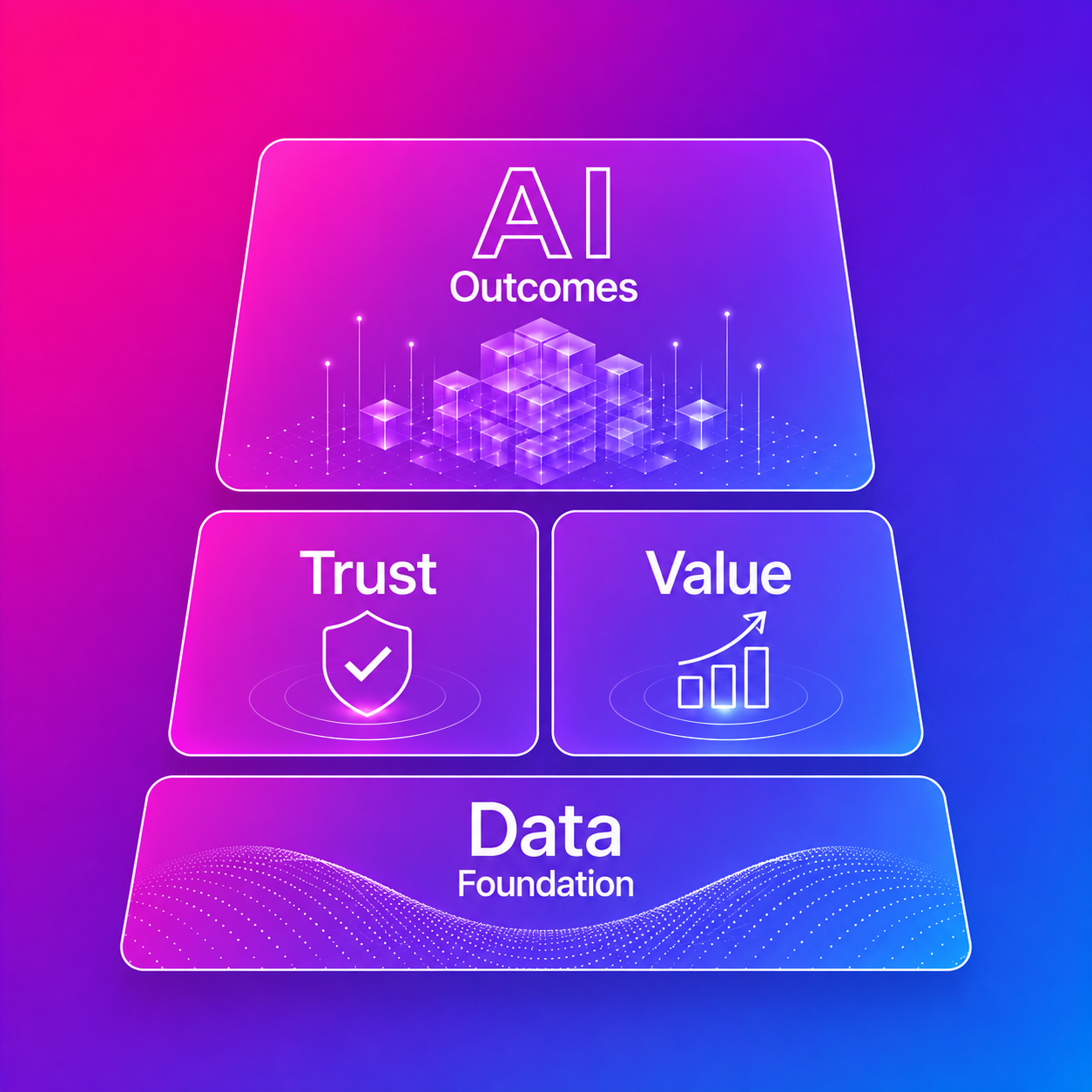
Data → metadata → meaning → trusted context → AI action
As AI moves closer to taking action rather than simply generating text, the quality of each preceding layer becomes more important.
Not every organization needs to buy three separate products labelled “data catalog,” “semantic layer,” and “context layer.”
What matters is whether the capabilities exist.
If your catalog already contains rich business context and can expose it to AI, it may provide a significant part of your context architecture. If your AI use cases depend heavily on standardized metrics, your semantic layer will be critical. If knowledge is fragmented across several systems, you will need a way to connect and activate it.
Start with the questions your AI applications need to answer, then work backwards to the context required.
If you are moving from architecture into technology evaluation, continue with how to evaluate context layer tools.
DataGalaxy brings together several of the foundations required for enterprise AI context.
The DataGalaxy Catalog connects technical metadata with business knowledge, ownership, lineage, governance, and data products. The Business Glossary helps establish shared definitions, while data lineage connects information with its sources, transformations, and dependencies.
Through the DataGalaxy MCP Server, that governed knowledge can also be accessed by compatible AI systems.
The goal is not to create another isolated context repository. It is to make the knowledge your organization already governs usable by both people and AI.
No. A data catalog organizes and governs knowledge about enterprise data. A context layer makes relevant organizational knowledge available to AI and other consumers at the point where it is needed. A modern catalog can provide a significant part of that context.
No. A semantic layer standardizes metrics, entities, dimensions, and business logic. A context layer can combine those semantics with ownership, lineage, quality, policies, provenance, and other organizational knowledge.
A modern catalog can provide much of the foundation if its metadata, definitions, ownership, lineage, and governance knowledge can be accessed by AI applications.
No. MCP is a mechanism for connecting AI applications to external systems. It can provide access to context, but the underlying knowledge still needs to be created and governed.
Yes. They provide consistent metrics and business logic that can prevent AI systems from independently interpreting company-specific analytical concepts.
Enterprise AI does not need another isolated source of truth. It needs access to the trusted knowledge your organization has already built around its data.
Explore the DataGalaxy Catalog and see how business meaning, metadata, lineage, and governance can become a shared foundation for people and AI.
Product Marketing Manager